
Concrete grades confuse a lot of people, and honestly, I get it. The numbers look similar, the mix looks the same, but the difference between C20 and C25 concrete can make or break a project.
C20 concrete has a compressive strength of 20 N/mm², and C25 has a compressive strength of 25 N/mm². C25 is stronger. But strength is only part of the story. The grade you choose depends on the load your structure will carry, the exposure conditions, and what the building regulations in your area require.
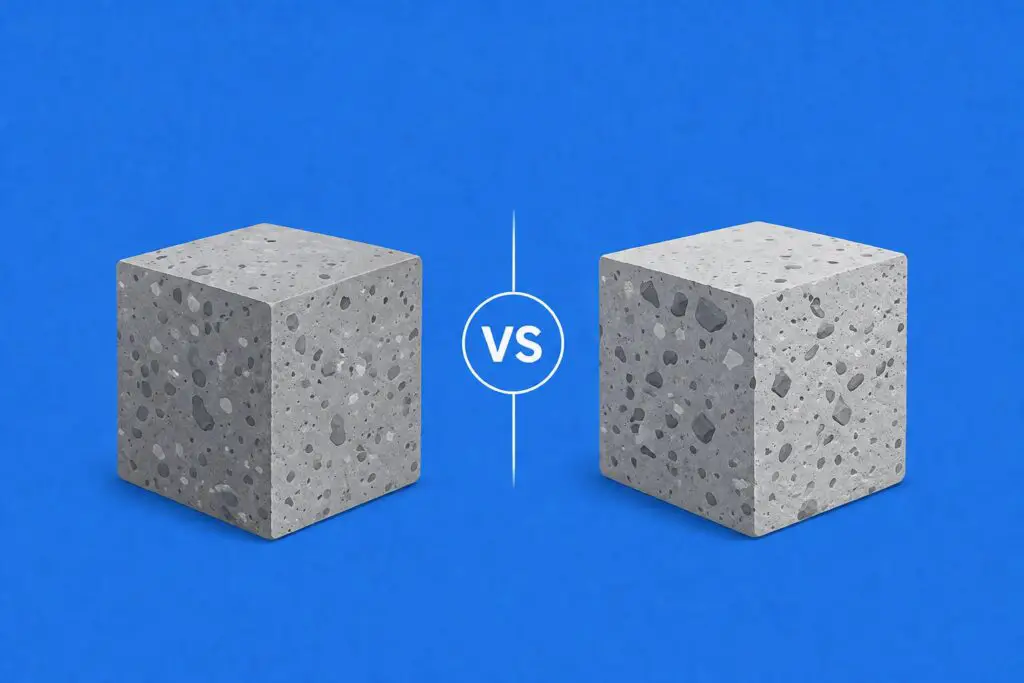
The Strength Gap and Why It Actually Matters
Compressive strength is measured after 28 days of curing. That is the standard. When a concrete mix is labelled C20, it means a standard cube of that concrete can withstand 20 newtons of force per square millimetre before it cracks. C25 handles 25 N/mm².
That 5 N/mm² gap sounds small. In practice, it is a 25% increase in load-bearing capacity. On a domestic garden wall, you probably will not notice the difference. On a concrete floor slab in a warehouse, that gap matters enormously.
The grade also affects how the concrete behaves under tension, freeze-thaw cycles, and moisture ingress. A higher grade mix typically uses a lower water-to-cement ratio, which means fewer internal voids, better durability, and less permeability to water.
The Mix Ratio Difference
The two grades are achieved by adjusting the proportions of cement, sand, aggregate, and water.
| Property | C20 Concrete | C25 Concrete |
|---|---|---|
| Compressive Strength | 20 N/mm² | 25 N/mm² |
| Typical Cement Content | 240 kg/m³ | 290 kg/m³ |
| Water-Cement Ratio | ~0.60 | ~0.50 |
| Density (approx.) | 2350 kg/m³ | 2400 kg/m³ |
| Slump Range | 75 mm | 75 mm |
| Typical Setting Time | 2 to 6 hours | 2 to 6 hours |
The lower water-cement ratio in C25 is what drives its superior strength. Less water means a denser hydrated cement paste and a stronger final product. It also means C25 is slightly less workable unless plasticisers are added.
Where Each Grade Gets Used
This is the practical bit most people actually need.
C20 Concrete: Typical Applications
C20 is a general-purpose grade. It works well in situations where loads are modest and exposure to harsh weather is limited.
You will find C20 used in:
- Domestic driveways and pathways
- Garden walls and boundary walls
- Non-structural floor slabs in garages
- Mass concrete filling and blinding layers
- Small shed bases and outbuildings
- Internal domestic floor screeds
If you are pouring a concrete base for a garden shed or laying a path in your back garden, C20 is usually sufficient. It is easier to work with, slightly cheaper, and perfectly adequate for light-duty applications.
C25 Concrete: Typical Applications
C25 is the step up you need when structural performance matters.
Common uses include:
- House foundations and strip footings
- Reinforced concrete slabs (ground-bearing and suspended)
- Retaining walls under moderate load
- External concrete steps and ramps
- Swimming pools and water-retaining structures
- Commercial car parks and loading areas
- Agricultural buildings under regular vehicle use
According to The Concrete Society, C25 is one of the most commonly specified grades for reinforced concrete elements in domestic and light commercial construction. When you are working with steel reinforcement bars, the concrete needs to bond properly and protect the steel from corrosion. C25 gives you that protection better than C20.
Cost Difference: Is It Worth Paying More for C25?
The price difference between C20 and C25 is not dramatic. In the UK, ready-mix concrete prices in 2026 typically sit around £90 to £120 per cubic metre for C20 and £100 to £135 per cubic metre for C25, depending on your location, supplier, and order volume. That is roughly a 10 to 15% premium for C25.
On a small job, say 2 cubic metres for a garage floor slab, the difference might be £20 to £30 total. That is not a meaningful saving if you later end up with cracking, damp ingress, or a floor that cannot handle the loads you put on it.
My honest take: if you are anywhere near the boundary between the two grades, go with C25. The cost difference is minor. The performance headroom is real.
Durability and Exposure Classes
This is where people often miss something important. British Standards and Eurocodes classify concrete by exposure class, not just strength.
| Exposure Class | Description | Minimum Grade |
|---|---|---|
| XC1 | Dry or permanently wet | C20/25 |
| XC2 | Wet, rarely dry | C25/30 |
| XC3/XC4 | Moderate to high humidity | C30/37 |
| XF1 | Moderate freeze-thaw exposure | C25/30 |
| XF3/XF4 | High freeze-thaw with de-icing salts | C30/37 or C35/45 |
You will notice C20 does not appear in most structural exposure classes at all. For anything exposed to the elements on a permanent basis, C25 is typically the minimum grade that complies with current standards.
If you are building in the UK, BS 8500 is the standard that governs concrete specification. It is worth cross-referencing your application against that document or asking your structural engineer to do so. The Building Research Establishment guidance on concrete durability also covers this in detail for those who want to dig deeper.
Reinforced vs Unreinforced: Does It Change the Grade You Need?
Yes, significantly.
Unreinforced concrete relies entirely on its own compressive strength. Reinforced concrete uses steel to handle tensile loads, but the grade of concrete still determines how well it grips the steel and how resistant it is to cracking and corrosion.
For reinforced concrete, structural engineers in the UK almost always specify C25 as a minimum, and C30 or higher is increasingly common for structural slabs and beams. The reason is bond strength between rebar and concrete, and the cover required to protect steel from carbonation.
If you are adding reinforcement to a slab or foundation, do not use C20. The structural calculations and code compliance simply will not add up.
Workability on Site
C20 is marginally easier to work with. The higher water content makes it flow and settle more readily. This is actually useful for complex formwork or intricate shapes where you need the concrete to fill every corner without much vibration.
C25, with its lower water-cement ratio, is stiffer. In practice, you can add a plasticiser (superplasticiser) to improve workability without compromising strength. Any good ready-mix supplier will offer this as an additive. It adds a small cost but gives you C25 strength with C20 workability.
If you are mixing on site rather than ordering ready-mix, achieving a consistent C25 is harder. The mix ratios need to be precise, the water content tightly controlled, and the curing conditions managed properly. For anything structural, I would strongly recommend ordering ready-mix concrete with a certified mix design rather than mixing by hand or using a small drum mixer.
Curing: Does It Differ Between C20 and C25?
The curing process is largely the same for both grades, but C25 benefits more from proper curing practice because the low water-cement ratio means there is less free water in the mix. If the surface dries out too quickly, hydration stops prematurely and the concrete never reaches its full design strength.
Keep these curing principles in mind for both grades:
- Cover freshly poured concrete with polythene sheeting or hessian within a couple of hours of finishing
- Avoid pouring in temperatures below 5°C or above 30°C without protective measures
- Allow at least 7 days before applying significant load
- Full design strength is reached at 28 days
Cold weather slows the hydration reaction dramatically. In winter conditions, C25 is more vulnerable to frost damage before it has cured properly, so blanket protection is especially important.
Structural Engineer’s Perspective
If a structural engineer has specified C25 on your drawings, do not downgrade to C20 to save money. The specification will have been set based on load calculations, exposure conditions, and code compliance. Changing the grade without re-running those calculations is a risk you do not want to take.
If there is no structural engineer involved and you are making the call yourself on a domestic project, use C25 for anything that carries a load or sits in the ground. Use C20 for purely aesthetic or light-duty applications like paths, patios, or filling.
Quick Decision Table
| Application | Recommended Grade |
|---|---|
| Garden path or patio | C20 |
| Garage floor slab (unreinforced) | C20 |
| Driveway (light vehicles) | C20 or C25 |
| Shed or outbuilding base | C20 |
| House strip foundation | C25 |
| Reinforced concrete slab | C25 minimum |
| Retaining wall | C25 |
| External steps or ramps | C25 |
| Swimming pool structure | C25 to C30 |
| Commercial floor (vehicles) | C25 to C30 |
Conclusion
C20 and C25 are both widely used, reliable concrete grades. The core difference is compressive strength, 20 N/mm² versus 25 N/mm², and that 25% gap has real consequences for structural applications, reinforced elements, and anything exposed to moisture or freeze-thaw cycles.
C20 is fine for light, non-structural domestic work. C25 is the right choice for foundations, reinforced slabs, retaining walls, and anything that will carry a meaningful load or face regular exposure to the elements.
The cost difference between the two is small. The performance difference is not. In most cases where you are unsure, C25 is the safer and smarter specification.
FAQs
Can I use C20 concrete for a driveway that gets used by heavy vans?
C20 will technically hold a van’s weight in the short term, but it is not ideal for repeated heavy vehicle use. Heavy vans, especially loaded ones, can generate significant point loads and lateral stress on the surface. I would use C25 for any driveway that sees regular traffic from vehicles over 2 tonnes. Add a minimum slab thickness of 150 mm and consider reinforcing with A142 mesh to prevent cracking over time.
My builder quoted for C20 on my house foundations. Should I be worried?
It depends on what your structural drawings specify and what the soil conditions are. For traditional strip foundations on stable ground in low-risk exposure conditions, C20 has historically been used. But current UK building practice and BS 8500 increasingly point toward C25 for foundations, particularly in XC2 exposure conditions which most buried concrete falls into. I would ask your builder to confirm this against the structural engineer’s specification before proceeding.
Does C25 concrete take longer to set than C20?
No, the initial setting time is broadly similar for both grades, typically between 2 and 6 hours depending on temperature and admixtures. The difference is in the rate of strength gain during curing. C25 can actually gain strength slightly faster in the early days due to its higher cement content, though both grades reach their design strength at 28 days.
Is self-mix C25 as strong as ready-mix C25?
Rarely. Achieving a consistent C25 on site requires precise batching of materials, accurate water measurement, and proper testing. Ready-mix concrete is produced under controlled conditions with tested materials and certified mix designs. If you are batching by hand or with a small mixer, you may end up with something closer to C15 to C20 in practice, even if you intend to make C25. For structural applications, always use certified ready-mix.
Can C20 and C25 be poured against each other in the same structure?
Technically yes, but it is not good practice without engineering justification. Different grades can have slightly different thermal expansion and shrinkage characteristics, and the interface between them can become a weak point. In practice, most structures are specified at a single grade throughout. If you need to top up or patch existing concrete, try to match the original grade and ensure proper bonding with a concrete bonding agent.